Updated7 min readProduct Guide
Aluminum Foil Roasting Pans: Deep Trays, Large Trays, and Oven Use
Select aluminum foil roasting pans for turkey, chicken, BBQ, catering, oven food, party trays, grease control, rim strength, and export packing.

Quick Answer
Choose a foil roasting pan from the cooked load and support route: food mass, grease volume, center of gravity, rim grip, oven or grill support, drainage requirement, hold time, and the way the hot pan is transferred and served. A non-perforated grill tray such as S820, perforated SR820, and deeper container route such as SV889 perform different jobs. Always test the pan with the real food, appliance support, catch tray or rack, cooking cycle, hot lift, rest period, serving utensils, and disposal route; empty-pan stiffness is not a hot-load rating.
Separate roasting, grease capture, and grilling decisions
The word roasting pan covers several load paths. A deep pan may contain a heavy roast and liquid; a shallow solid tray may catch grease or support smaller food; a perforated tray intentionally lets heat, smoke, and rendered liquid move through openings. Substituting one route for another changes both cooking behavior and where hot grease goes.
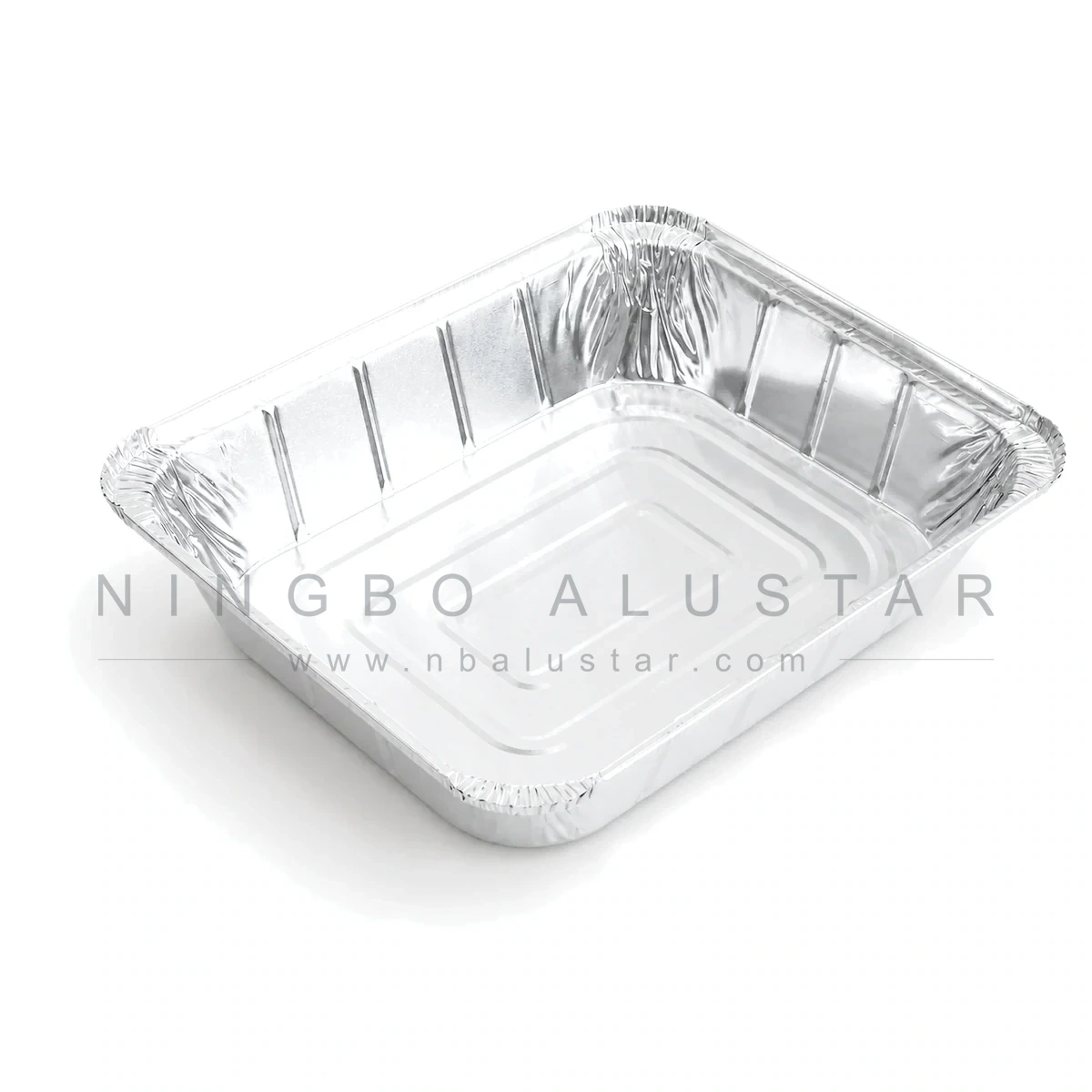
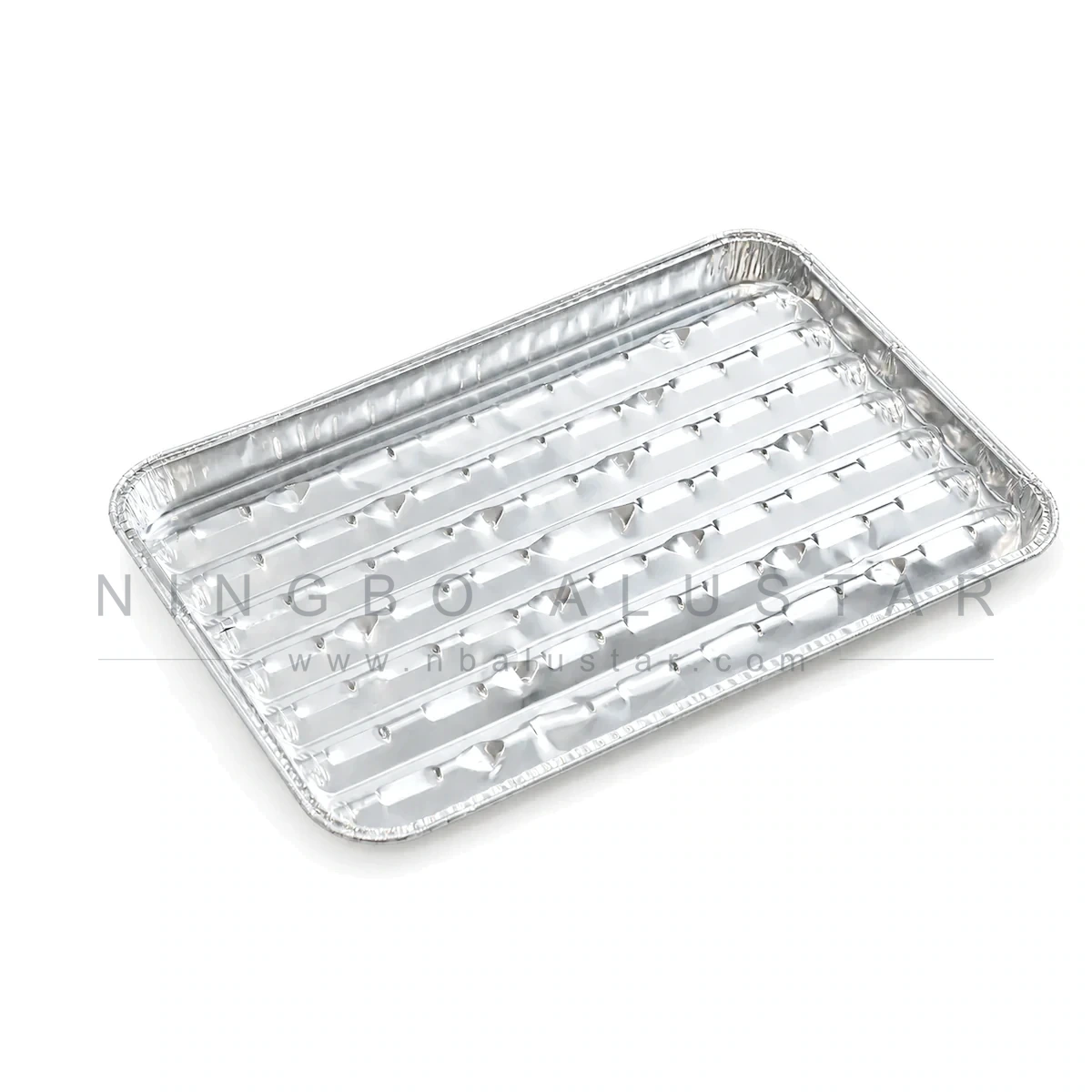
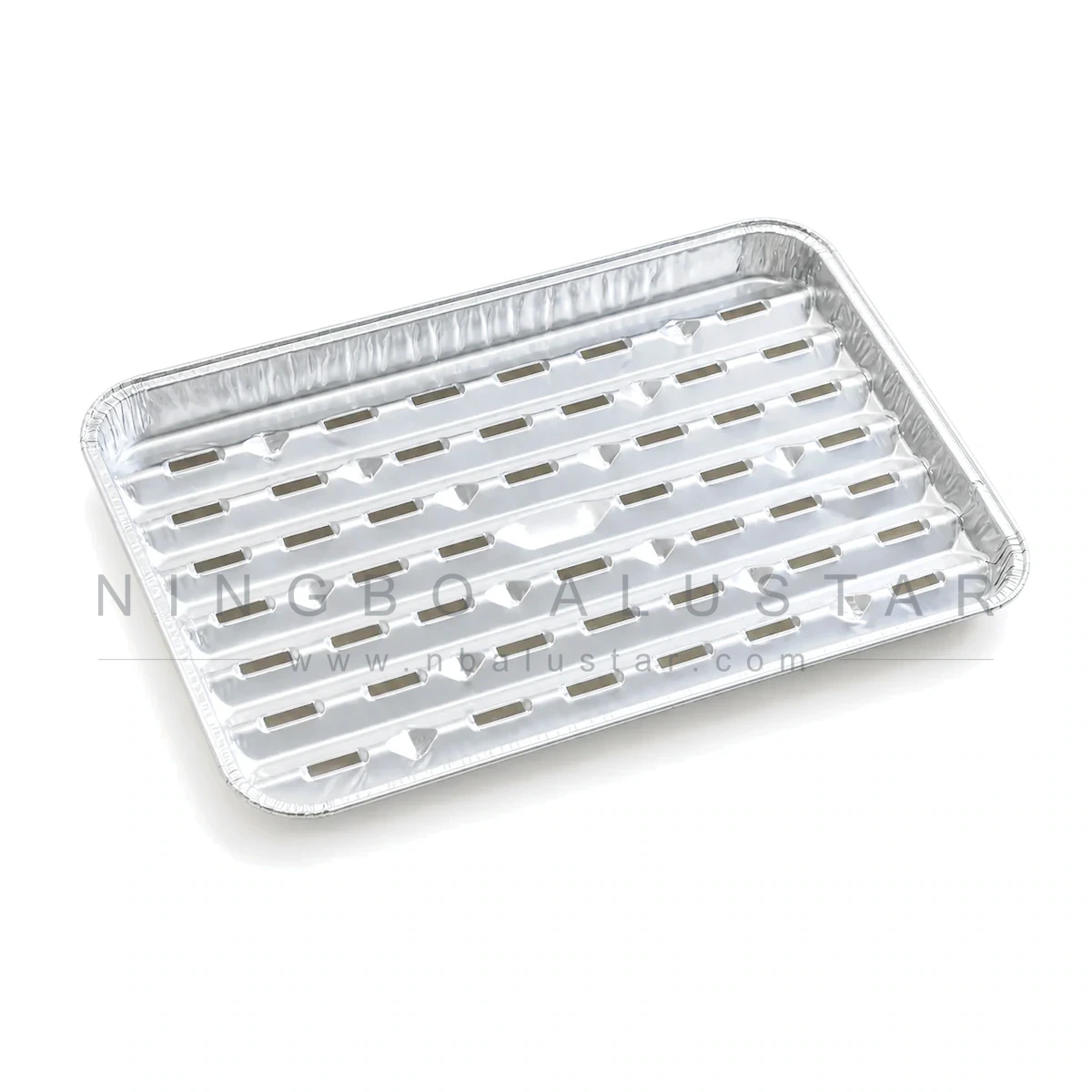
Alustar's S820 is an existing non-perforated grill-tray route, SR820 an existing perforated grill-tray route, and SV889 a deeper vertical-rim container route. Use these as clearly separated sample families and confirm the final application in the intended equipment rather than assigning a use from overall length or appearance.
| Cooking job | Format characteristic to prioritize | Critical evidence |
|---|---|---|
| Heavy roast with juices | Depth, continuous base, rim and supported lift | Hot filled-load transfer without buckling or spill |
| Grease-catching tray | Solid base, lip containment, stable placement | Expected grease remains controlled through removal |
| Direct grilling with drainage | Purpose-designed perforations and secondary grease route | Food support plus safe collection below |
| Buffet hold or serving | Warm rim stability, utensil access, cover fit | Hold-time shape and serving trial |
| Seasonal retail roast kit | Consumer instructions, outer pack, accessory control | Complete kit use and transport simulation |
Design the support system for a hot, shifting load
A cold roast is a concentrated load; during cooking, fat and juices redistribute, the food softens, and the foil loses some handling stiffness as temperature rises. The pan, rack, baking sheet, and operator's grip form one support system. State whether the foil pan must always sit on a rigid carrier and keep that instruction visible through preparation and service.
Test every transfer: refrigerator to preparation area, preparation to appliance, appliance to rest surface, rest surface to carving or buffet, and final disposal. The weakest event is often not cooking but an unsupported hot lift across a long span. Define grip locations and whether two hands, a board, or a sheet pan are required.
- State the maximum approved food-and-liquid load for the validated route.
- Mark support and grip points on operator or consumer instructions.
- Evaluate the pan both before cooking and after the planned rest period.
- Include carving, spooning, or tong loads that press on one side of the pan.
Control grease differently in solid and perforated pans
A solid pan retains rendered liquid, which can raise the free-liquid level during removal and change browning around the food. A perforated pan directs liquid elsewhere, so the complete system must include a compatible collector and stable spacing. Never assess a perforated tray on an appliance without defining what receives the drainage.
Use the highest credible grease and juice yield from the approved menu, not a dry substitute. Observe pooling, overflow path, flare-up exposure, blocked perforations, and the moment the pan is tilted or removed. The equipment manufacturer and site operating rules remain part of the approval; foil format alone does not authorize an appliance setup.
- Record expected retained or drained liquid at the end of cooking.
- For perforated formats, approve the collector and spacing as part of the system.
- Challenge openings with the smallest approved food pieces and seasoning particles.
- Inspect the removal route for uncontrolled tilt or hot-liquid transfer.
Validate from raw loading to hot disposal
Begin with the pan on its intended support and load the real food at the approved upper limit. Include marinade, vegetables, racks, liners, or accessories that are part of the program. Record base contact, center of gravity, rim condition, and any point load before placing the system in the appliance.
After the real cooking cycle, assess it without correcting the pan by hand. Photograph the hot shape, measure retained liquid where relevant, perform the defined supported lift, rest for the planned time, carve or serve, cover or hold if required, and follow the disposal route. Repeat at different equipment positions when heat or support conditions vary across the appliance.
| Validation moment | Pan condition to inspect | Failure that blocks release |
|---|---|---|
| Raw loading | Point loads, food fit, rim contamination | Food or accessory damages the pan or closure zone |
| Peak cooking | Support, drainage, local sag | Unsafe contact, blocked drainage, or unstable seating |
| Hot removal | Grip, carrier, liquid movement | Buckling, uncontrolled tilt, or spill |
| Rest and service | Shape, utensil load, cover fit | Pan twists, rim collapses, or service becomes unsafe |
| Disposal | Residual heat, sharp folds, remaining liquid | Handling instruction cannot control the hazard |
Plan seasonal retail and export packs before the peak
Roasting programs often concentrate demand around holidays, promotions, or barbecue seasons. Freeze the approved pan, accessory, support instruction, label, unit pack, carton, and forecast early enough to run a representative packing trial. A last-minute carton-count increase can deform rims and undermine the hot-load result established with earlier samples.
Consumer packs need instructions that match the validated route: whether rigid support is required, how to lift, what to do with grease, and which included accessories belong above or below the pan. Test readability after retail handling and confirm that nested pans, racks, lids, or inserts cannot be assembled in an unsafe order.
- Lock the final nesting count before printing consumer instructions.
- Run one complete kit from shelf pack through cooking and disposal.
- Keep perforated and non-perforated variants unmistakably separated.
- Retest hot handling after any tray, accessory, or carton change.
Avoid roasting-pan errors that appear only when hot
An empty hand-flex test is the most misleading shortcut because it omits food mass, redistributed grease, temperature, support gaps, and the leverage of a real lift. Another error is testing the cook but not the removal, rest, carving, or disposal steps where the pan receives asymmetric force.
Teams also interchange perforated and solid trays, place a shallow pan across unsupported rack gaps, or publish generic oven instructions before qualifying the exact kit. The corrective controls are specific: approved system drawing, named support, worst-case menu load, hot transfer method, grease route, and change-triggered revalidation.
- Do not rate hot-load performance from an empty pan.
- Do not use perforations without an approved drainage collector.
- Do not test cooking while omitting hot removal and service.
- Do not change nesting or accessories without repeating the complete route.
Source Disposable Aluminum Baking Pans for Retail or Food Service
Disposable Aluminum Baking Pans should be matched to the recipe weight, oven temperature, bake time, base support, release requirement, rim, display lid, and consumer handling instructions. Large roasting pans and small bakery formats need different strength, nesting, and carton protection, even when both are sold as disposable bakeware.
Bakeries, supermarkets, food processors, retail brands, caterers, and distributors are welcome to purchase baking pans from Alustar. Send the recipe or use, target dimensions, filled weight, oven route, lid or label, retail pack, order quantity, and destination for product matching and sampling.
- Test the heaviest recipe at the maximum declared oven condition.
- Define whether a baking sheet or rack must support the pan during handling.
- Check release, edge safety, deformation, browning, lid fit, and shelf presentation.
- Approve retail artwork and cooking instructions against the tested use route.
Direct B2B procurement
Catering Foil Tray Manufacturer
Source full-size, half-size, deep, roasting, and party trays for hotels, events, central kitchens, hot holding, transport, and service.
View solutionSources and further reading
Continue this buying path
Use these related guides to move from initial selection to specifications, compliance, and supplier evaluation.
Product Guide
Rectangular Aluminum Foil Containers: Takeout, Catering, and Ready Meal Buyer Guide
Read guideApplication Guide
Aluminum Foil Containers for Catering: Full-Size, Half-Size, and Party Trays Buyer Guide
Read guideMediterranean Food Packaging
Aluminum Foil Containers for Mediterranean Family Meals and Catering
Read guideHoliday Roasting Packaging
Thanksgiving Aluminum Foil Roasting Pans for Turkey, Sides, and Holiday Catering
Read guideRelated aluminum foil products
Buyer next steps
FAQ
What is the difference between S820 and SR820?
S820 is an existing non-perforated grill-tray route and SR820 an existing perforated route. The perforated system needs a defined collector and drainage path; neither should replace the other without a complete cooking and hot-handling trial.
Can an aluminum foil roasting pan be lifted by its rim when hot?
Only if that exact filled route has been validated and the approved instruction permits it. Heavy hot food and liquid often require a rigid sheet, board, or other support plus defined two-hand grip points.
How should a perforated foil grill tray be tested?
Test it with the smallest approved food pieces, expected seasoning and grease yield, the named appliance support, spacing, and collector. Observe blockage, food support, drainage, hot removal, and the complete grease path.
What changes require a roasting-pan revalidation?
Revalidate changes to the pan or material, rim, perforation, food load, accessory, support, appliance route, closure, nesting count, carton, or consumer instruction because any of them can alter hot handling or grease control.