Updated6 min readCompliance
Aluminum Foil Container Certificates: Food Contact, BRCGS, REACH, and Migration Testing Explained
Understand aluminum foil container certificates, food-contact migration testing, BRCGS packaging, REACH, supplier files, and buyer document review.
Quick Answer
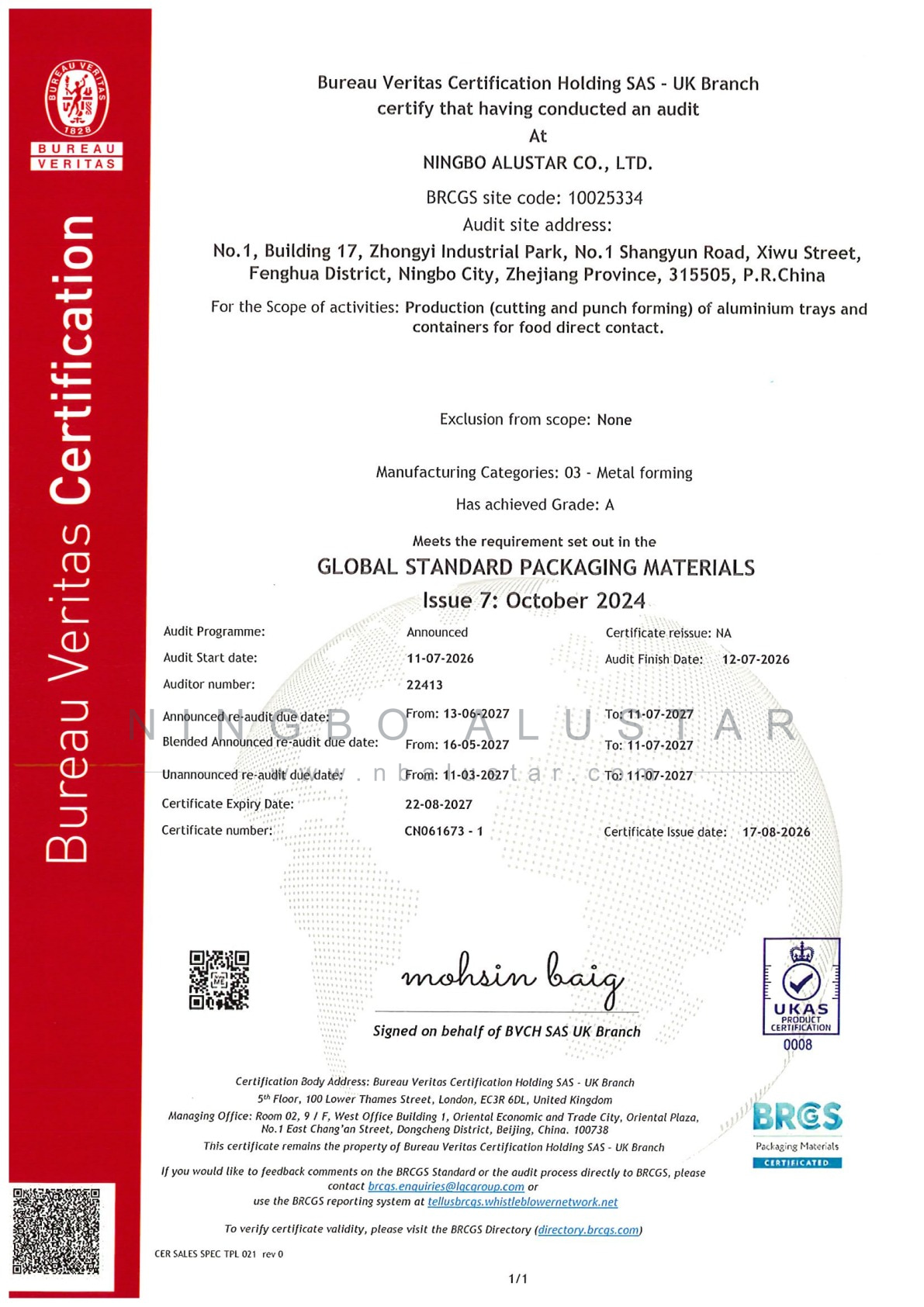
An aluminum foil container document pack should separate four questions: how the manufacturing site is managed, what the product is made from, what a specific sample was tested for, and who declares compliance for a stated market and use. BRCGS, food-contact test reports, REACH information, supplier declarations, and laboratory accreditation are not interchangeable. Verify each document's issuer, legal entity, site, product or sample, scope, conditions, date, status, and link to the ordered construction.
Classify the document before judging it
The word certificate is used loosely in packaging trade. A site-audit certificate, laboratory test report, declaration, chemical-information statement, and raw-material certificate each answer a different question. Build a document register by function instead of collecting logos and cover pages.
A strong file also records what a document does not prove. This prevents a valid certificate from being used for the wrong purchasing decision, such as using a site-management audit to approve the migration behavior of an untested coating.
| Document type | What it can support | What it does not prove alone | Key verification fields |
|---|---|---|---|
| BRCGS Packaging Materials or similar site certification | Management system and activities within the certified site's stated scope | That every product or food-contact condition passed migration testing | Certificate owner, site address, scope, grade/status, issue/expiry and certification body |
| Food-contact laboratory report | Results for the identified sample under named methods and conditions | All products, formulations, markets, or future batches | Full report, sample identity, method, simulants, time/temperature, results, lab and date |
| Supplier declaration or statement | The responsible supplier's stated conformity and use limits | Independent certification or testing beyond referenced support | Legal entity, product list, regulations, conditions, signatory, date and supporting references |
| REACH or SVHC information | Chemical-information duties or substance status within the stated scope | Food-contact suitability, migration performance, or approval for a market | Product/material identity, candidate-list reference date, threshold logic and supplier |
| Raw-material certificate or CoA | Batch or material identity and listed composition or properties | Finished-pack performance, coating, lid, print, or intended-use compliance | Supplier, material code, batch, specification, result and link to production lot |
| Laboratory accreditation | Competence for activities listed in the accreditation scope | That every report from the organization covers every method or passed result | Accreditation body, number, status, location and exact scope |
Build a requirement matrix for the destination and customer
Start with the responsible importer, destination, intended food and use conditions, complete pack construction, and customer onboarding standard. Then determine which legal evidence, declarations, audits, test reports, and commercial records are required. A retailer may request documents beyond the legal baseline, while a certificate popular in one market may be irrelevant in another.
Use accurate regulatory language. FDA-related compliance support is not the same as a universal FDA-issued product certificate. LFGB is a German legal reference, not a global certification mark. REACH information serves chemical obligations and does not replace food-contact assessment. The responsible business or qualified adviser should resolve uncertain applicability before production.
- Separate legal requirements from customer policy and voluntary site certification.
- List tray, coating, print, lid, adhesive, and film as separate evidence lines.
- Record required test conditions rather than naming a market alone.
- Assign who prepares, reviews, approves, updates, and supplies each document.
Verify identity, scope, status, and authenticity
Read beyond the first page. Compare the company name and address with the quotation, invoice, manufacturing site, and public company records where appropriate. Confirm that product descriptions, material codes, photographs, formulation references, and sample dates can be connected to the proposed order.
Use issuer directories, QR codes, report-verification portals, or direct confirmation when available, but inspect the scope even after authenticity is confirmed. A genuine certificate can still be unrelated to the selling company, site, product, or process being purchased.
- Keep every page, appendix, result table and referenced sample description.
- Check issue, expiry, suspension or withdrawal status and the date the scope was reviewed.
- Confirm the certification or laboratory body's identity and relevant accreditation scope.
- Record translations separately and retain the controlling original document.
Link documents to the product and production lot
A complete file should let a reviewer move in both directions: from the order to every supporting document, and from a report sample back to the current product, material suppliers, and lot. Create a controlled evidence map rather than storing unrelated PDFs in one folder.
- List the exact tray, coating, ink, lid, adhesive, film, artwork, and supplier reference.
- Assign each item the applicable report, declaration, certificate, use limit, and review owner.
- Compare approved samples and specification revisions with the production bill of materials.
- Check batch or incoming-material records during pre-shipment inspection where agreed.
- Release the order only after gaps, substitutions, expired documents, and deviations are resolved in writing.
Avoid certificate-review errors
The most expensive document mistake is not always a forged certificate. More often, a real document is treated as broader than its actual site, sample, method, material, condition, or validity.
- Do not treat BRCGS certification as product-specific migration evidence.
- Do not treat REACH or an SVHC statement as food-contact approval.
- Do not call a supplier declaration independent third-party certification.
- Do not apply one report to every color, coating, lid, adhesive, or temperature route without documented justification.
- Do not accept a laboratory logo without checking that the reported method falls within the relevant scope.
- Do not change a report date in marketing copy or imply a newer test than the document shows.
Maintain a living compliance register
For each document, record owner, issuer, number, product or site scope, destination, conditions, issue and review dates, status, storage path, verification method, and next action. Review the register before quotation, sampling, production, shipment, and any material or supplier change rather than waiting for customs or a retailer audit.
Alustar can provide available site-audit, material, and food-contact documents for review and can arrange project-specific discussion or testing when needed. The buyer should state its destination and customer matrix so the final file is approved for the actual order, not described as a universal certificate pack.
Sources and further reading
Continue this buying path
Use these related guides to move from initial selection to specifications, compliance, and supplier evaluation.
Compliance Guide
Global Food-Contact Requirements Guide: FDA, EU, SABER, Japan, Halal, and Kosher
Read guideCompliance
Food-Grade Aluminum Foil Containers: What Buyers Should Check Before Importing
Read guideQuality Guide
Aluminum Foil Container Quality Inspection Checklist Before Shipment
Read guideSustainability
Aluminum Foil Containers vs Plastic Containers: Heat, Recycling, Cost, and Food Service Use
Read guideRelated aluminum foil products
Buyer next steps
FAQ
Does BRCGS certification prove that a foil container is food-contact compliant?
Not by itself. BRCGS Packaging Materials certification can support confidence in the certified site's management system and stated scope. Product construction, food-contact conditions, migration or other required evidence, and destination obligations still need separate review.
Is a REACH report the same as a food-contact test?
No. REACH or SVHC information addresses chemical obligations within its stated scope. It does not by itself establish that a finished tray, coating, lid, or film is suitable for a particular food, temperature, duration, or food-contact market requirement.
How can buyers verify a packaging certificate?
Check the complete document, legal entity, site, scope, number, dates, status, certification body, and any public verification route. Then confirm that the genuine document actually relates to the manufacturing site, product, process, and order being evaluated.
When does a food-contact report need review or new testing?
Review it when the material supplier, formulation, coating, print, lid, adhesive, film, manufacturing site, process, intended food, time/temperature route, destination requirement, or report status changes. Whether new testing is needed depends on the documented impact and applicable requirement.
What should be included in an aluminum foil container compliance file?
Include the product and component specification, supplier and site identities, bill of materials, contact sides, intended-use matrix, applicable declarations, test reports, site certificates, raw-material records, approved samples, artwork and instructions, verification notes, revision history, and change approvals.